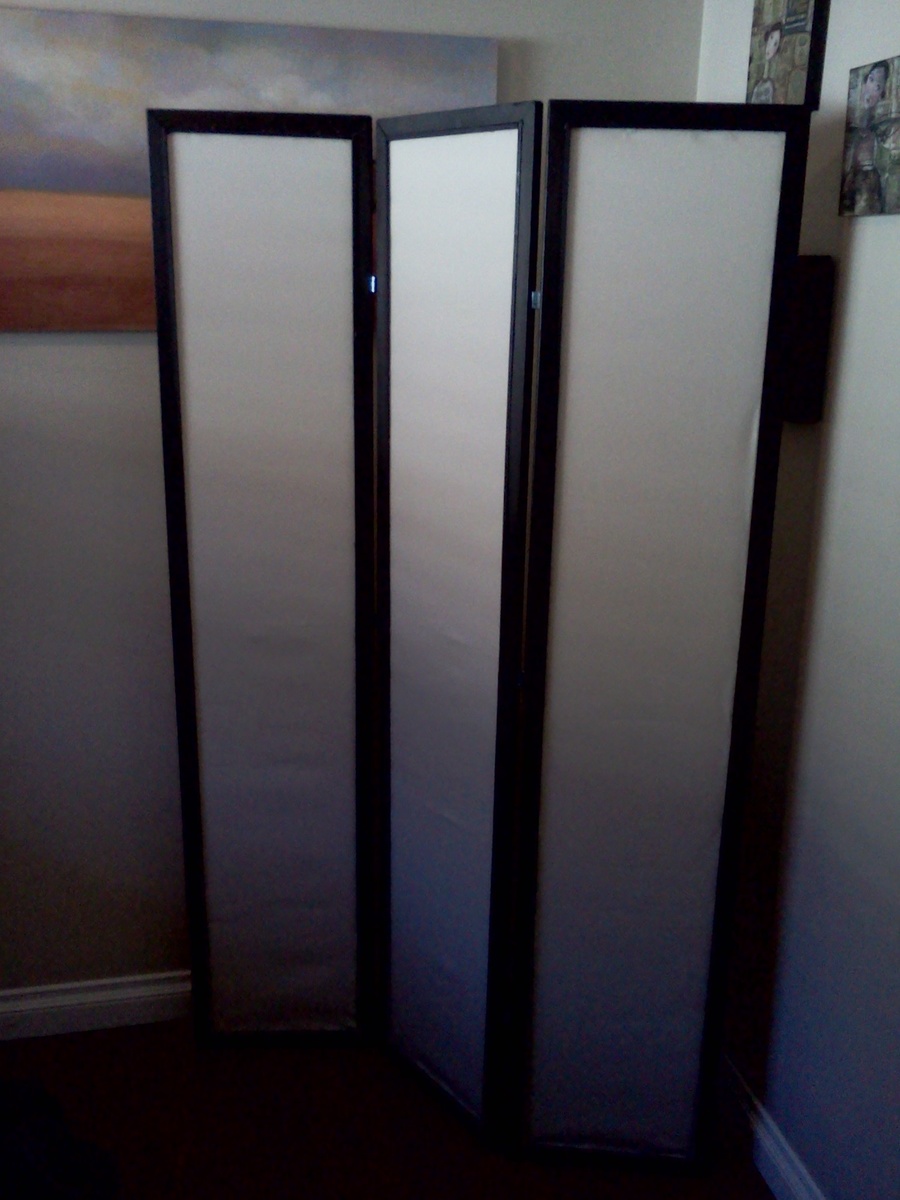


With already a guest in our guest room, we hosted a second guest in our living room. Needing to create some privacy, none of the premade shoji screens out there fit our decor. I wanted something more simple, warm and sturdy for our 1-year-old to be around than a screen made with rice paper. This decorative screen was made in a weekend and was a fun project. Enjoy.
Preparation
9 1x2x6'
15 3' length 1/4" square dowels
2 yards cotton fabric
4 narrow, medium duty hinges
Frames:
6 1x2x72" mitered 45 degrees at both ends
6 1x2x14" mitered 45 degrees at both ends
Fabric:
3 14" x 70" sheets of fabric
Once you have cut your 1x2s, take them to your table saw and route out a notch deep and long enough for the 1/4" dowels to fit into (or use a dado blade if you have one). Consider a 3/8" cut to make room for the staples and fabric that will sit under the 1/4" dowels.


Please read through the entire plan and all comments before beginning this project. It is also advisable to review the Getting Started Section. Take all necessary precautions to build safely and smartly. Work on a clean level surface, free of imperfections or debris. Always use straight boards. Check for square after each step. Always predrill holes before attaching with screws. Use glue with finish nails for a stronger hold. Wipe excess glue off bare wood for stained projects, as dried glue will not take stain. Be safe, have fun, and ask for help if you need it. Good luck!
Instructions
Step 1
Once you have cut your pieces, lay them out to ensure proper fit. Then, drill a pilot hole at the end of each of the short pieces, approximately 3/4-1" from the ends into the 45 degree angled sections (this is where your screws will connect to the larger 1x2s). Do this for all 12 ends of the shorter boards.
Step 2
Using screws and finish nails, connect one long board and one short board to make a right angled L-shaped piece of wood. Use a clamp to ensure proper fit. Do this 6 times. Then, repeat the process and connect all 6 Ls together. You’ll have 3 rectangular frames.
Step 3
Paint or stain your project now. I used General Finishes Java Gel Stain. Make sure project dries completely as you don’t want to get any stain onto your fabric. Don’t forget to stain the square dowels.
Step 4
Once wood is dry, lay pieces of fabric into frames. Stretch to provide desired tautness while using staple gun to affix fabric to frames. Do this for all 3 frames (TIP: first affix one long side, then one short side, then, pull the fabric to desired tautness and staple on the next long side and “seal” at the last short end). You’re nearly there! Three frames that just now need to be doweled and attached.
Step 5

Step 6

Using your hinges, attach at the top and bottom (I measured 1’ in from the ends), and you’re done.
It is always recommended to apply a test coat on a hidden area or scrap piece to ensure color evenness and adhesion. Use primer or wood conditioner as needed.
Comments
George Mulak (not verified)
Tue, 01/08/2013 - 14:55
Do not get the dowels
It is a very nice looking piece! I do have one clarification however, I am assuming that the dowels fasten the fabric to the frame by pushing it in. I can't see it as my picture is too dark. Is that what using the dado is for? Thank you for this, great idea!
dcostillo
Tue, 01/08/2013 - 15:42
Hi, George, Thanks for
Hi, George,
Thanks for looking. Yes, the square dowels act as a trim to cover the edge of the fabric and the staples. I glue gunned them on though you could possibly use carpenter's glue and clamps.